- Home
- About
- Treatments
- Testimonials
- Gallery
- Blogs
- Technology
- Contact
- Schedule A Consultation
Looking for summer skincare tips that actually work for your skin type and the weather outside? Most “summer skincare” advice treats June
and July as one long, identical season — but dermatologists know better. June heat is dry and UV-intense, while July heat brings monsoon
humidity that creates a completely different set of skin problems. If you're using the same routine for both months, that mismatch is likely why
your skin still struggles every summer.
This guide breaks down dermatologist-recommended skincare tips separately for June and July, so you can protect your skin barrier against exactly what
each month throws at it.
Your skin barrier is the outer layer that locks moisture in and keeps irritants out. In June, peak UV intensity (the sun reaches its strongest point around
June 21st) combines with dry heat that pulls moisture out of skin through evaporation. The dominant risks are sun damage, dehydration, and premature
aging.
In July, especially across India and other monsoon-affected regions, heat persists but now mixes with high humidity. Sweat sits on the skin instead of
evaporating, mixing with oil and bacteria. The dominant risks shift to clogged pores, acne breakouts, and fungal skin infections.
Same season, two different skin emergencies. Here's how dermatologists recommend handling each one.
SUN DEFENSE · HYDRATION LOCK-IN
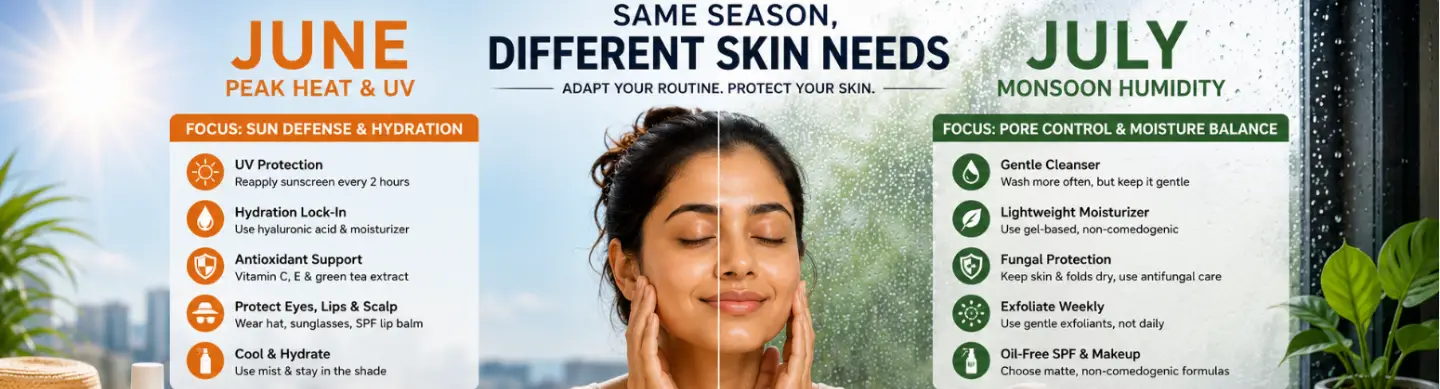
June calls for sun defense and aggressive hydration. These are the most effective, dermatologist-backed June skincare tips.
A single morning SPF application will not protect your skin through a full June day. Use a broad-spectrum sunscreen with SPF 30–50, ideally a mineral
formula with zinc oxide or titanium dioxide, which sits on the skin and deflects UV rays rather than absorbing them. Reapply every two hours of sun exposure, and every 80 minutes if you're sweating heavily.
Dry June heat increases water loss through both sweat and evaporation, leaving skin tight, dull, or flaky even without visible sweating. Apply a hyaluronic acid serum under a lightweight moisturizer so skin can actually retain hydration instead of losing it to the air. Drink water consistently through the day —
dehydrated skin shows up as dullness and more visible fine lines.
Vitamin C, vitamin E, and green tea extract neutralize the free radicals generated by intense June UV exposure before they damage skin cells and accelerate collagen breakdown. Apply your antioxidant serum first, then layer sunscreen over it for more complete protection than sunscreen alone provides.
UV damage isn't limited to your face. Use an SPF lip balm, UV-blocking sunglasses, and a hat with a wide brim — every extra inch of brim meaningfully
reduces UV exposure to covered skin. A scarf or light cap also protects your scalp's hairline and part, an area people frequently forget to protect.
Between roughly 11 a.m. and 3 p.m., June UV intensity is at its highest. Keep a thermal or cooling facial mist on hand to refresh skin and reduce heattriggered redness, and seek shade whenever possible rather than relying on sunscreen alone to carry the full load.
PORE CONTROL · MOISTURE BALANCE
July calls for pore control and moisture balance rather than dryness prevention. These are the dermatologist-recommended July skincare tips for humid, monsoon conditions.
Humidity increases oil and sweat production, which mixes with leftover sunscreen and grime to clog pores faster than in drier months. Washing your face
more frequently is appropriate in July, but pair that with a soap-free, non-stripping cleanser. Blot sweat with a clean cloth throughout the day instead of letting it sit on skin.
A stripped or damaged barrier can actually trigger your skin to produce more oil to compensate, so cutting out moisturizer to control shine often backfires. Use a lightweight, non-comedogenic, gel-based moisturizer with niacinamide or ceramides, which support the barrier without clogging pores.
Monsoon humidity creates ideal conditions for fungal overgrowth, especially in skin folds, between toes, and under jewelry or watch straps. Keep these areas dry throughout the day, change out of damp clothing or wet shoes promptly, and use an antifungal powder in high-friction areas if you're prone to this.
Excess oil and sweat can leave pores feeling congested, but daily scrubs or harsh exfoliants sensitize skin further in humid weather. Stick to a gentle
chemical exfoliant or soft clay mask once a week to clear pores without compromising the barrier.
If you wear makeup or tinted sunscreen in July, choose oil-free, non-comedogenic, mattifying formulas. Heavy or creamy products combined with humiditydriven sweat are a common, overlooked cause of monsoon breakouts that people often blame on diet or stress instead.
| Focus Area | June (Dry Heat) | July (Monsoon Humidity) |
| Main Threat | UV exposure, dehydration | Excess oil, clogged pores, fungal risk |
| Cleanser | Hydrating, non-stripping | Gentle, used more frequently |
| Moisturizer | Rich in hyaluronic acid | Lightweight, gel-based, non-comedogenic |
| Extra Step | Antioxidant serum + SPF | Antifungal care in damp areas |
| Exfoliation | Minimal, hydration-focused | Weekly, pore-focused |
Neither is universally “worse” — they're harmful in different ways. June causes more dehydration and UV-driven aging, while July causes more breakouts and fungal issues from humidity.
You don't need to switch SPF level, but a matte or gel-based sunscreen often feels more comfortable in July's humidity, while a hydrating sunscreen can support drier June skin.
It's better to lighten your moisturizer as humidity rises in July. A richer formula that works in dry June heat can feel heavy and contribute to clogged pores once monsoon humidity sets in.
June and July aren't the same season for your skin. June asks you to block intense, dry-heat UV exposure and lock moisture in.
July asks you to manage humidity, sweat, and oil without stripping your barrier. Build your routine around what each month is
actually doing to your skin, and the “summer skin problems” most people accept as inevitable become mostly preventable.
This article reflects current dermatologist-reviewed guidance on summer skincare. It is for general informational purposes and isn't a substitute for personalized advice — if you're dealing with persistent irritation, breakouts, or sun damage, a board-certified dermatologist can tailor a routine to your specific skin type and climate.
Disclaimer :The website content is created with the aim of imparting knowledge and information about the domain called Dermatology among the people. The treatments mentioned here must not be taken as prescriptions. Also, the result for any treatment will vary from person to person as per the skin and hair condition.